
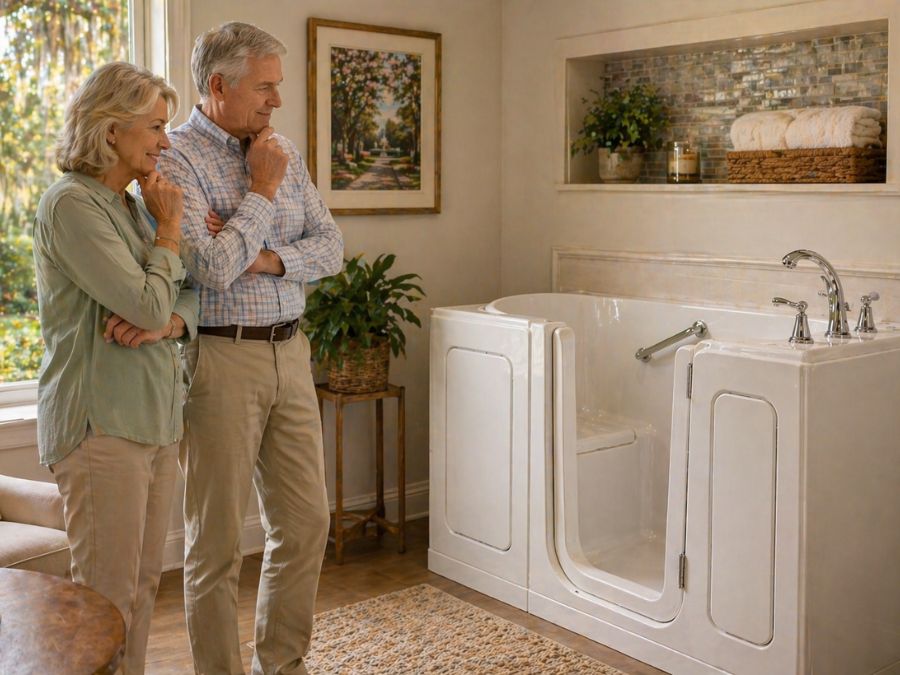
Are Walk-In Tubs Worth It for Aging in Place in Savannah?
Yes, walk-in tubs are often worth it for aging in place in Savannah because they improve bathroom safety, reduce fall risk, and help seniors stay independent longer. Their value depends on mobility needs, home conditions, and whether the features will be used consistently.
Why This Question Matters More in Savannah Than Most Places
In Savannah, aging in place comes with a unique set of conditions that don’t always show up in newer markets. Many homes were built decades ago, often with smaller bathrooms, higher tub walls, and layouts that weren’t designed for long-term accessibility. That doesn’t make them unlivable, it just means they need to adapt over time.
Humidity also plays a role in how these homes function. Bathrooms tend to stay damp longer, and surfaces can become slick more easily. Even a well-maintained space can feel less predictable when moisture is part of the equation year-round. That’s why safety concerns tend to show up earlier in the bathroom than anywhere else.
For families in Savannah, the question isn’t just whether a walk-in tub is a good product. It’s whether it solves a real problem in a home that wasn’t built with aging in place in mind.
The Real Value: Preventing Falls Before They Happen
One of the biggest reasons families consider a walk-in tub is to reduce the risk of falls. The transition into a traditional bathtub, stepping over the edge while balancing on a wet surface is one of the most common points of failure in the home.
A walk-in tub removes that movement entirely. Instead of stepping up and over, the user enters through a low threshold and sits down immediately. That change reduces the need for balance and minimizes the chance of slipping at the most vulnerable moment.
What makes this valuable isn’t just the physical safety. It’s the ability to maintain independence. When a daily routine feels manageable again, people are far more likely to continue doing it themselves rather than relying on help or avoiding it altogether.
In many homes, that shift happens quietly but quickly. What used to feel risky becomes routine again.
Where Walk-In Tubs Make the Biggest Difference
Walk-in tubs tend to deliver the most value when they’re installed at the right time, not too early, but not too late either. In Savannah homes, that often means recognizing the early signs of difficulty rather than waiting for a fall to force the decision.
Those signs are usually subtle. Taking extra time to step into the tub, holding onto nearby surfaces for support, or skipping baths more often than before. These changes are easy to overlook, but they’re often the clearest indicator that the setup needs to evolve.
They also make a significant difference in households where a caregiver is involved. A safer, more stable bathing environment reduces strain and makes assistance more predictable. That can improve the experience for both the person receiving help and the person providing it.
In these situations, the value of a walk-in tub shows up immediately and continues over time.
The Trade-Offs Most People Don’t Think About at First
Even when a walk-in tub is a strong fit, there are practical considerations that should be understood upfront. The most common one is cost. Walk-in tubs typically range from mid to higher investment levels depending on features and installation complexity, especially in older Savannah homes where adjustments may be needed.
Another factor is time. Unlike a standard shower, a walk-in tub requires the user to sit while it fills and drains. For some people, this becomes part of a relaxing routine. For others, especially those who prefer a quicker process, it can take some getting used to.
Water usage and system capacity also come into play. Walk-in tubs hold more water than traditional tubs, which means the home’s water heater and plumbing system need to be able to keep up. In many Savannah homes, this is manageable with minor adjustments, but it’s something that should be evaluated early.
These trade-offs don’t outweigh the benefits for most families, but understanding them ahead of time makes the decision more informed and realistic.
Installation Realities in Savannah Homes
Installation is often more straightforward than homeowners expect, but Savannah homes do bring specific conditions into the process. Older plumbing systems, uneven subfloors, and tight bathroom layouts are all common factors that need to be addressed.
The process typically starts with removing the existing tub and assessing what’s behind it. This is where most of the variability comes in. Some homes allow for a quick replacement, while others require minor updates to ensure everything fits and functions correctly.
In raised homes, access underneath can make plumbing work easier. In slab homes, adjustments may be more precise but still manageable. Electrical upgrades may also be required if the tub includes powered features like jets or heated seating.
Most installations are completed within two to three days, but the timeline depends on how much preparation is needed. The key is understanding the home before work begins so there are no surprises during the process.
How It Compares to Other Aging-in-Place Options
Walk-in tubs are one of several ways to improve bathroom safety, but they’re not the only option. Some homeowners consider walk-in showers, grab bars, or smaller modifications instead.
The difference is in how complete the solution is. Smaller upgrades can improve safety, but they don’t always remove the core challenge of stepping over a tub wall. A walk-in tub addresses that issue directly, which is why it tends to be more impactful.
That said, it’s important to match the solution to the person. In some homes, a walk-in shower may be the better choice, especially if sitting for longer periods isn’t ideal. The goal isn’t to install the most advanced option, it’s to install the one that fits daily life best.
Long-Term Value: More Than Just the Bathroom
When people ask if a walk-in tub is worth it, they’re often thinking about the upfront cost. But the long-term value is usually tied to what it prevents and what it allows.
A safer bathroom can reduce the likelihood of falls, which are often the turning point that leads to more significant changes in living arrangements. Avoiding that outcome can extend the time someone is able to stay in their home comfortably.
There’s also a quality-of-life factor that doesn’t always get discussed. When daily routines feel easier and less stressful, it has a ripple effect on overall well-being. That consistency matters more than most people expect.
In some cases, accessibility features can also make a home more appealing to future buyers, especially in areas where aging in place is common. While that isn’t always the primary goal, it can add to the overall value of the investment.
When a Walk-In Tub Is Worth It and When It’s Not
A walk-in tub is worth it when it clearly improves safety and fits naturally into daily routines. That usually means there’s some level of mobility concern, a desire to stay in the home long term, and a willingness to use the tub regularly.
It may not be the best fit if mobility is already severely limited or if the user cannot comfortably sit through the bathing process. In those cases, other solutions may be more appropriate.
The most important factor is alignment. The tub should match the person’s needs, the home’s layout, and the way the space is actually used. When those pieces line up, the decision tends to feel clear.
A Decision That Should Feel Clear, Not Rushed
Most families don’t ask this question casually. It usually comes from noticing that something in the home no longer feels as safe as it once did.
In Savannah, where homes often hold years of meaning, staying in place matters. The goal isn’t to change the home completely, it’s to make sure it continues to support daily life in a safe and practical way.
If you’re considering whether a walk-in tub is worth it, the next step is simply understanding what would work in your space. Schedule a no-pressure home safety assessment to get a clear, realistic picture of what makes the most sense moving forward.

Jason James is Co-Founder and Director of Sales at Home Mobility Solutions, serving homeowners across the Hilton Head Island–Bluffton–Port Royal, SC Metro Area with walk-in tubs, stair lifts, home elevators, and other accessibility upgrades. He moved to the Lowcountry in 1993 and built a career in residential and commercial construction before founding Lowcountry Walk-In Tubs in 2009 to help seniors and people with disabilities bathe safely at home. That company grew into Home Mobility Solutions, where Jason now leads sales and client relationships across Bluffton, Hilton Head Island, Beaufort, Ridgeland, and Hardeeville.