
Walk In Tub vs Roll In Shower for Hilton Head Seniors
Quick Answer:
For most Hilton Head seniors, a walk-in tub is best for comfort, stability, and therapeutic relief, while a roll-in shower is better for ease of access, faster use, and long-term mobility changes. The right choice depends on how safely someone can move today and how their needs may change over time. In Lowcountry homes, layout, moisture, and construction style often influence which option works best.
Making the Right Choice for Your Needs
For many families in Hilton Head, this decision doesn’t start with a renovation plan. It starts with a moment.
A missed step getting out of the tub. A close call that could have gone worse. An adult child visiting and realizing the bathroom no longer feels safe. What used to be routine suddenly feels risky.
From there, the question becomes practical but emotional at the same time. How do you make the home safer without making it feel clinical or unfamiliar? How do you choose something that works now but still makes sense years down the road?
A walk-in tub and a roll-in shower both solve safety problems, but they do it in very different ways. The right choice comes down to how the space is used, how mobility is changing, and what will truly make daily life easier.
The Real Difference Between a Walk-In Tub and a Roll-In Shower
At a surface level, these options look similar, but they are built for different needs.
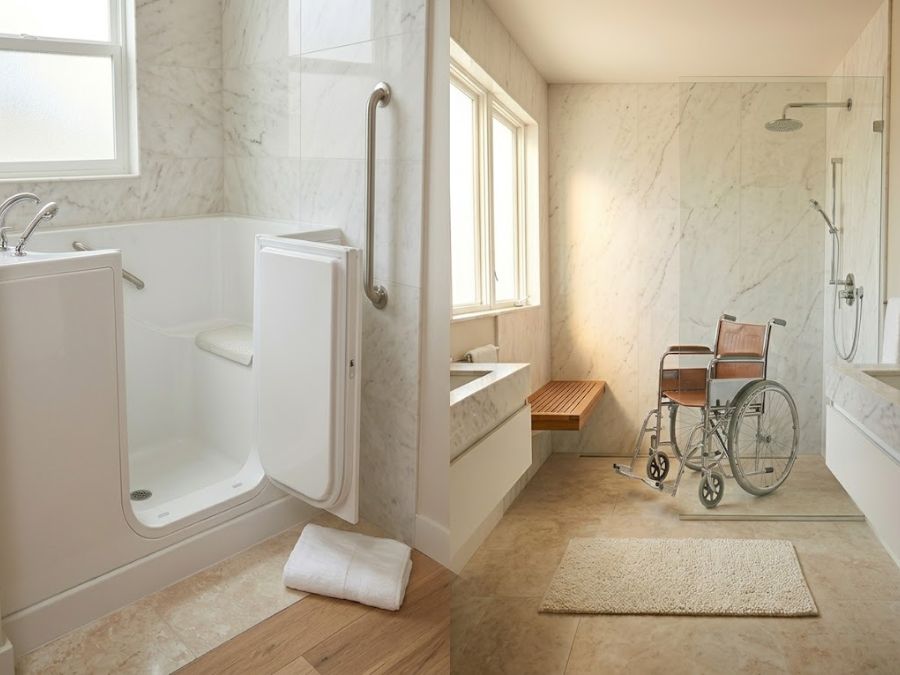
A walk-in tub is designed around sitting and soaking safely. It includes a low step entry, a built-in seat, and a watertight door that allows the tub to fill once the user is inside.
A roll-in shower removes barriers altogether. There is no threshold to step over, which allows someone to walk in or enter with a walker or wheelchair. It focuses on ease, speed, and accessibility.
Both improve safety, but the right choice depends on how much support is needed and how the bathroom needs to function day to day.
When a Walk-In Tub Is the Right Fit
A walk-in tub tends to work well for seniors who are still fairly mobile but want to reduce risk and stay independent.
One of the biggest advantages is stability. Sitting down on a built-in seat is far safer than lowering into a traditional tub. Grab bars, anti-slip surfaces, and easy controls create a controlled environment where everything is within reach.
There is also a comfort factor that matters more than people expect. Warm water, hydrotherapy jets, and soaking can help with joint pain, stiffness, and circulation. For many homeowners, this turns bathing back into something they enjoy instead of something they worry about.
In many Hilton Head homes, especially those with an existing tub layout, this type of installation can often be completed without a full bathroom reconstruction. That makes it a practical first step for improving safety while keeping the space familiar.
At the same time, there are realities that experienced installers always walk homeowners through. The user needs to sit inside the tub while it fills and again while it drains. Even with fast-drain systems, that waiting period can feel longer than expected. This tends to become a deciding factor for families thinking a few years ahead.
When a Roll-In Shower Makes More Sense
A roll-in shower becomes the better option when ease of access is the priority.
There is no door, no step, and no waiting. Entry and exit are immediate, which reduces hesitation and lowers fall risk. For seniors using walkers or wheelchairs, this design removes one of the biggest barriers in the home.
Caregivers also benefit from this layout. In many Bluffton and Hilton Head homes, families find that assisting in a traditional tub or even a walk-in tub becomes difficult over time. A roll-in shower creates the space needed to help safely without strain.
Local construction plays a role here as well. Many homes in the Lowcountry are built on slab foundations, which means creating a true zero-entry shower requires careful planning. Proper slope, drainage, and waterproofing are critical. This is where experience matters, because small installation mistakes can lead to long-term moisture issues in a humid coastal environment.
When done correctly, a roll-in shower becomes one of the most future-ready upgrades a home can have.
What Most Homeowners in Hilton Head Don’t Realize
There are a few consistent surprises that come up in these projects.
One is how quickly needs can change. A solution that feels perfect today can become limiting if mobility declines even slightly.
Another is how important moisture control is in this region. Between humidity and salt air, bathrooms in the Hilton Head area experience more wear than many inland homes. Proper waterproofing is not optional.
Space is also a factor. Many older homes were not designed with accessibility in mind. Tight layouts can limit what is possible without more extensive modifications.
These are the kinds of details that homeowners often only discover after starting the process, but they tend to shape the success of the final result.
How to Choose Between a Walk-In Tub and a Roll In Shower
For most families, the decision becomes clearer when you focus on daily use rather than features.
If the senior can still move independently, prefers soaking, and wants a safer version of a familiar routine, a walk-in tub is often the right fit.
If mobility is already limited, if a walker or wheelchair is involved, or if caregiver assistance is part of the picture, a roll-in shower usually makes more sense.
Bathroom layout matters as well. In many homes, replacing an existing tub is more straightforward, while creating a roll-in shower may require opening up the space. The more flexibility there is in the layout, the more future-ready the solution can be.
A common situation in Hilton Head homes is choosing a solution that works not just for today, but for where things may be heading. That forward thinking often prevents the need for another renovation later.
Cost and Installation Considerations
Cost is part of the decision, but understanding what drives that cost is more important.
Walk-in tubs are generally more predictable. Installation typically involves removing the existing tub, adjusting plumbing, and fitting the new unit. Some models require electrical upgrades depending on the features.
Roll-in showers vary more widely. A basic conversion is one thing, but creating a true zero entry design may involve structural adjustments, specialized waterproofing systems, and custom finishing work. The more the layout changes, the more variables come into play.
In many cases, the decision is not just about price, but about how much of the bathroom needs to be reworked to achieve the right outcome.
Planning for Safety and Peace of Mind
At the center of this decision is not the product. It is peace of mind.
Seniors want to feel safe without giving up independence. Adult children want to know their parents can move through the home without unnecessary risk. Both are trying to avoid a situation where a preventable fall changes everything.
The right choice is the one that removes daily friction. It should feel natural to use, not like an adjustment that adds stress or hesitation.
In Hilton Head homes, that often means balancing what is physically possible with what makes sense for the way the home is built. Local experience plays a role here because homes in this area come with specific challenges that need to be accounted for early.
If you are just starting to explore options, a home assessment can help clarify what will realistically work in your space and prevent costly missteps. Looking at the layout, understanding how the bathroom is used, and thinking a few steps ahead usually leads to a solution that feels right both now and in the years ahead.
Jason James is Co-Founder and Director of Sales at Home Mobility Solutions, serving homeowners across the Hilton Head Island–Bluffton–Port Royal, SC Metro Area with walk-in tubs, stair lifts, home elevators, and other accessibility upgrades. He moved to the Lowcountry in 1993 and built a career in residential and commercial construction before founding Lowcountry Walk-In Tubs in 2009 to help seniors and people with disabilities bathe safely at home. That company grew into Home Mobility Solutions, where Jason now leads sales and client relationships across Bluffton, Hilton Head Island, Beaufort, Ridgeland, and Hardeeville.