
Can a Walk In Tub Fit in My Existing Lowcountry Bathroom?
Quick Answer:
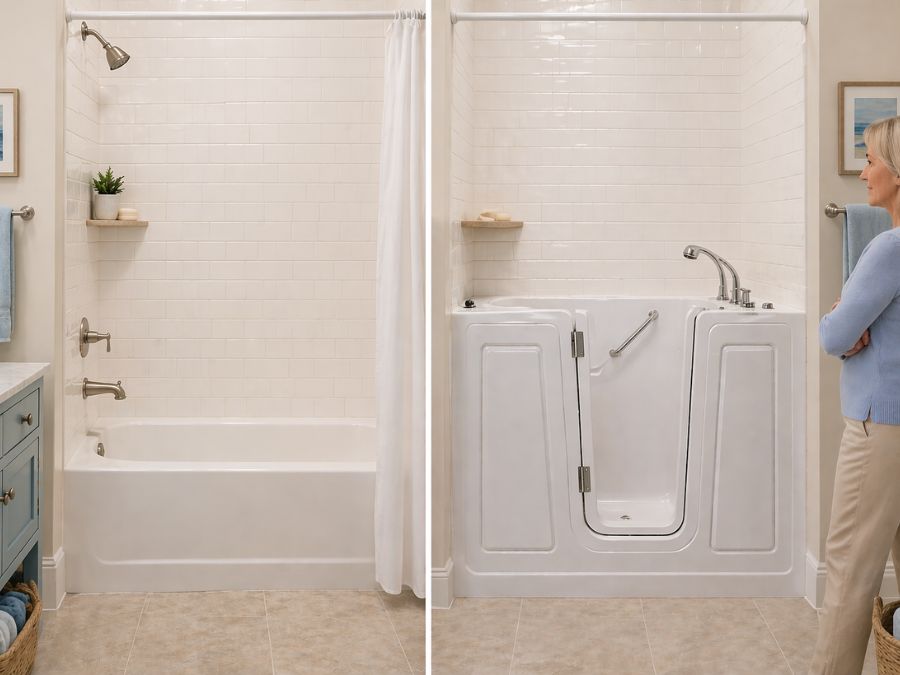
Yes, in most Lowcountry homes, a walk-in tub fits directly into the same space as your existing bathtub. A standard tub alcove is about 60 inches long and 30 inches wide, and most walk-in tubs are designed between 52 and 60 inches in length to fit within that footprint. In Bluffton, Hilton Head, and Beaufort homes, the existing tub is typically removed and replaced without expanding the space.
This Question Is Really About Avoiding a Major Renovation
When homeowners ask whether a walk-in tub will fit, they are rarely just asking about measurements. What they are really trying to understand is whether this turns into a major renovation.
They picture walls being opened, weeks of disruption, and a project that grows beyond what they expected. The concern is not just space. It is whether the bathroom they already have can realistically handle the change without becoming something much bigger.
In most Lowcountry homes, it does not.
Walk-in tubs are designed to replace what is already there, not expand the room or require structural changes.
What Your Bathroom Likely Looks Like Right Now
In Bluffton, Hilton Head, and Beaufort, most homes follow a consistent bathroom layout, especially those built in the past few decades.
If you currently have a standard bathtub, it is installed in a three-wall alcove that measures about five feet long and roughly two and a half feet wide. That structure was built specifically for a tub, which is exactly why it can be reused for a walk-in tub.
When you look at your bathroom, it may feel fixed and limited. In reality, that alcove is already the correct space for the upgrade.
How a Walk-In Tub Fits Into That Same Space
Walk-in tubs are intentionally designed to match the footprint of a standard tub opening.
Most models fall between 52 and 60 inches in length and maintain a similar width to traditional tubs. The added height comes from the seated design, which allows for a full soaking experience without requiring more floor space.
In a typical Lowcountry installation, the process is straightforward. The existing tub is removed, plumbing connections are adjusted to match the new unit, and the walk-in tub is installed in the same footprint.
The walls stay in place. The footprint stays the same. The function changes.
That is why, in the majority of homes, the answer is clearly yes—it fits.
Where Fit Issues Actually Come From
When a walk-in tub does not fit smoothly, the issue is rarely the size of the tub itself. The challenges come from the surrounding space.
Door clearance is one of the first considerations. Walk-in tubs include a watertight door, and that door needs room to open safely without obstruction. The direction of the door swing matters and must match the available space.
Plumbing placement is another factor, especially in Lowcountry homes built on slab foundations. The plumbing cannot simply be moved anywhere, so adjustments need to be planned around the existing system.
The layout around the tub also affects usability. Nearby vanities, toilets, or walls can influence how easily the space functions once the new tub is installed.
These are planning details—not structural barriers—but they need to be addressed early.
Lowcountry Bathroom Layout Realities
Homes in this region follow predictable building patterns, which makes planning more accurate.
In neighborhoods like The Crescent and many Bluffton developments, bathrooms often follow similar Pulte-style layouts. That consistency allows experienced installers to anticipate plumbing locations, clearances, and installation constraints before work begins.
Tile-heavy bathrooms are also common throughout Hilton Head and Bluffton homes. While these spaces look open, they often have tighter usable dimensions once fixtures are considered.
Another common configuration is a tub and shower combination. Converting this setup into a walk-in tub requires deciding whether to keep a shower function or prioritize seated bathing.
For homeowners in Sun City specifically, bathroom layouts follow even more consistent patterns. If that applies to your home, it’s worth reviewing our Sun City guide for a more detailed breakdown of how those layouts typically convert.
What Happens If Your Bathroom Is Smaller Than Average
Smaller bathrooms are a common concern, but they are rarely a stopping point.
Compact walk-in tubs are designed specifically for tighter spaces. These units use a deeper, seated design to deliver a full soak while reducing the overall length required.
In some homes, small layout adjustments create enough room to make the installation work comfortably. This might involve repositioning a nearby fixture or making minor changes to surrounding finishes.
What looks restrictive at first usually turns into a manageable design adjustment once the space is evaluated properly.
What Installation Actually Looks Like (Real Timeline)
One of the biggest misconceptions is how long installation takes.
For a straightforward replacement, the process is typically completed in 2 to 3 days. This includes removing the existing tub, making plumbing adjustments, installing the new unit, and sealing everything properly.
Projects take longer when additional changes are required, such as plumbing relocation or layout adjustments. That is why evaluating the space upfront makes a significant difference in both timing and cost.
What This Typically Costs in the Lowcountry
Cost is part of the same question, even when it is not asked directly.
In Bluffton, Hilton Head, and Beaufort, a straightforward walk-in tub replacement typically falls within a mid-to-high four-figure to low five-figure range, depending on the model, features, and installation requirements.
Projects involving plumbing changes, electrical upgrades, or layout adjustments will fall on the higher end of that range.
The key factor is not just the tub itself, but how well the installation fits the existing space.
When a Walk-In Tub Might Not Be the Right Fit
Even when a walk-in tub fits physically, it is not always the best solution.
Bathrooms with extremely limited movement space may function better with a walk-in or roll-in shower. Homes where caregiver access is required often benefit from a more open layout. And for homeowners who prioritize speed over soaking, a tub may not match daily routines.
The goal is not just to make the tub fit in the room. It is to make it work in real life.
How to Know for Sure in Your Home
While most Lowcountry homes follow predictable patterns, the only way to confirm fit is to evaluate the actual space.
This usually involves measuring the alcove, reviewing plumbing placement, and assessing the surrounding layout. In many cases, this can be done quickly, and the outcome is clear once those factors are understood.
Because of how consistent homes are in this region, the answer is often straightforward once the layout is reviewed.

Jason James is Co-Founder and Director of Sales at Home Mobility Solutions, serving homeowners across the Hilton Head Island–Bluffton–Port Royal, SC Metro Area with walk-in tubs, stair lifts, home elevators, and other accessibility upgrades. He moved to the Lowcountry in 1993 and built a career in residential and commercial construction before founding Lowcountry Walk-In Tubs in 2009 to help seniors and people with disabilities bathe safely at home. That company grew into Home Mobility Solutions, where Jason now leads sales and client relationships across Bluffton, Hilton Head Island, Beaufort, Ridgeland, and Hardeeville.